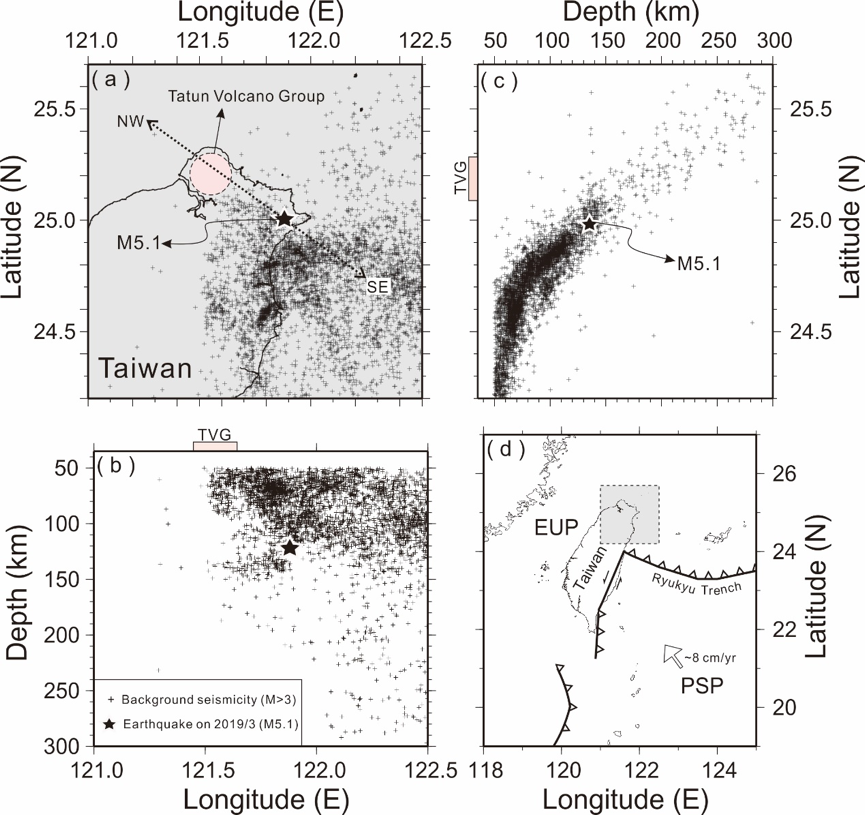
Fig. 1 (a)-(c) Projection of background seismicity (M > 3, depth > 50 km) and an earthquake (M = 5.1) on March 12, 2019 in northern Taiwan, and (d) the general tectonics in and around the Taiwan area.
This article has been submitted to Seismological Research Letters (SRL)
Major structures within the mantle wedge are often revealed from seismic velocity anomalies, such as low velocity zones at magma reservoirs, partial melting regions, or the upwelling asthenosphere. However, no significant seismic boundaries have been reported in the shallow mantle wedge beneath volcanic arcs. Here we present evidence for a strong seismic reflector dipping in the opposite direction of the subducting slab in the mantle wedge beneath northern Taiwan in the western end of the Ryukyu subduction system. We find two unambiguous P-waves generated by a deep earthquake (M5.1) at a depth of 132.5 km were clearly recorded by the dense seismic array (Formosa Array), composed of 140 broadband seismic stations with a station spacing of approximately 5 km in northern Taiwan. Forward modeling using both ray-tracing and travel-times shows that a seismic reflector exists beneath the Tatun volcano group around depths of 80 - 110 km. The reflector dips in the opposite direction of the subducting slab and is unlikely to be associated with mantle wedge corner flow. Instead, it probably belonged to parts of possible structures such as the asthenospheric flow, the mantle diapir or other undiscovered structures above the subducting slab. No matter what the seismic boundary is exactly, it might be associated with the active volcanism in the Tatun volcano group. The detailed geometry and mechanism of the seismic boundary in the mantle wedge will be obtained as the Formosa array collects more seismic data in the near future.
Fig. 1 (a)-(c) Projection of background seismicity (M > 3, depth > 50 km) and an earthquake (M = 5.1) on March 12, 2019 in northern Taiwan, and (d) the general tectonics in and around the Taiwan area.

Fig. 2 Dense seismic array and seismograms generated by an earthquake on 2019/3/12. (a) The locations of the dense broadband seismic array (Formosa Array) and the epicenter of a M5.1 earthquake in northern Taiwan, (b) the first-motion focal mechanism determined from the Formosa array, and (c) vertical seismograms recorded at the Formosa (FM) array and plotted with the epicentral distances.
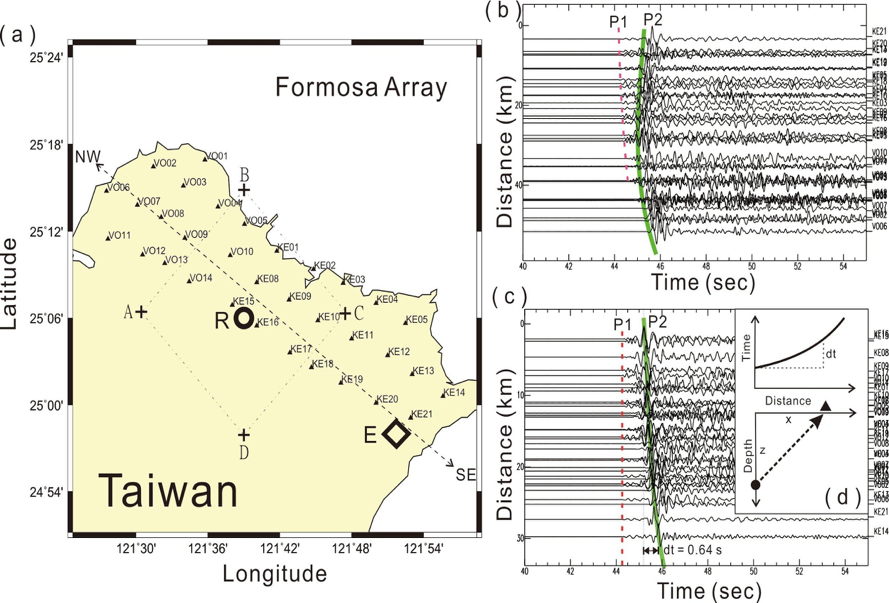
Fig. 3 (a) Locations of some seismic stations of the FM array and vertical seismograms plotted by the epicentral distance based on (b) the epicenter E and (c) another point R. The increasing travel times with horizontal distances are shown in (d).
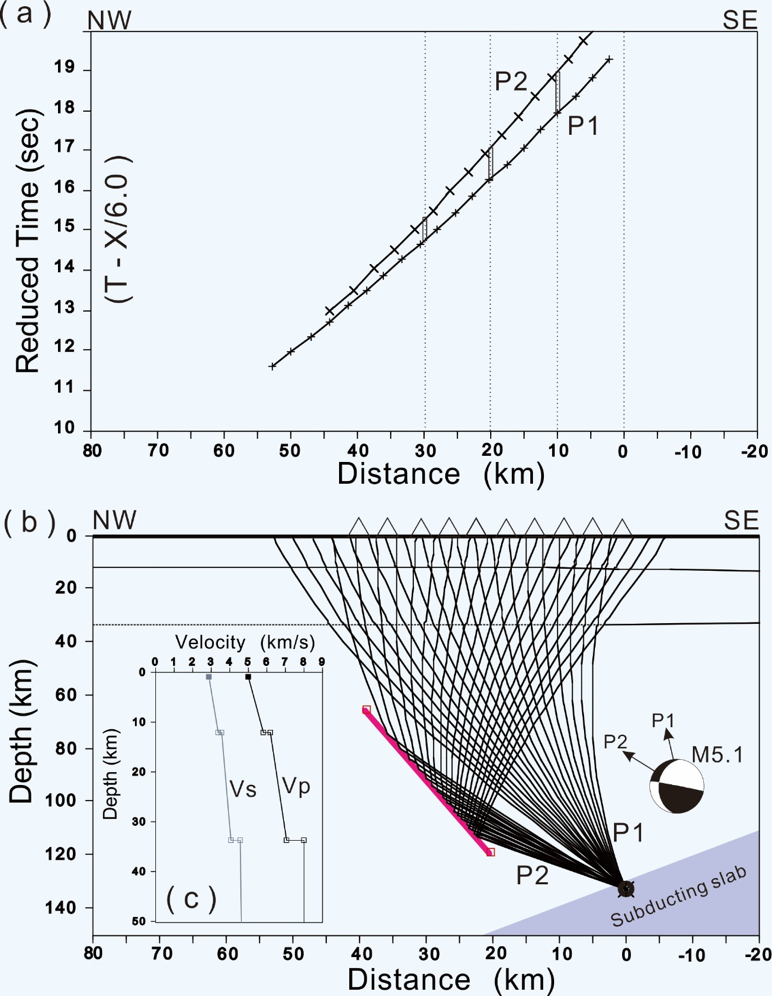
Fig. 4 Calculated results of (a) the travel-times of (b) two groups of ray-paths based on (c) the simplified 1-D velocity model across the NW-SE direction. P1 are the direct P-waves from the earthquake at a depth of 132.5 km, while the P2 are reflected from a dipping plane. The focal mechanism projected on the lateral hemisphere is shown for distinguishing the source-radiation variations between P1 and P2.
Last updated: 2019/10/03